
10+ Years
Learn software testing with an experienced QA and automation testing trainer.
With
Certification & 100% Placement Assistance
Classroom & Online Training | Live Projects | Industry Certification | 2–3 Months | Flexible EMI | Free Demo Class | Placement Assistance | Mock Interviews
Looking for the best Software Testing Course in Hyderabad? Playwright Masters offers practical software testing training covering Manual Testing, Automation Testing, SDLC, STLC, test case design, defect tracking, functional testing, regression testing, API testing, and database testing. Learn industry-relevant tools and technologies, including Selenium WebDriver, Playwright, Java, Python, TestNG, Maven, Git, Jenkins, and Jira. Gain hands-on experience with real-time projects, automation frameworks, Agile testing methodologies, and CI/CD integration. You’ll also explore AI tools like ChatGPT and GitHub Copilot to improve testing productivity. With experienced trainers, practical assignments, certification, interview preparation, and placement assistance, our Software Testing Training in Hyderabad helps freshers and working professionals develop the skills needed to become job-ready Software Test Engineers and QA Automation Engineers.
Table of Contents
Toggle| Course Information | Details |
|---|---|
| Trainer Name | Mr. Sandeep (Automation Testing Expert) |
| Trainer Experience | 10+ Years in Automation Testing & QA |
| Next Batch Date | 26-Oct-2026 06:00 PM – 07:00 PM |
| Training Mode | Classroom & Online Instructor-Led Training |
| Course Duration | 2–3 Months |
| Live Projects | 10+ Real-Time Automation Testing Projects |
| Certification | Industry-Recognized Course Completion Certificate |
| Placement Assistance | Resume Building, Mock Interviews & Placement Support |
| Contact Number | |
| Email Address | playwrightmasters.in@gmail.com |
| Free Demo Class | Enroll for a Free Demo Class Today |
Attend a free demo and review the selected plan’s assessment requirements and refund terms before enrolling.
Learn software testing with an experienced QA and automation testing trainer.
Prepare for software testing interviews with resume guidance and career support.
Practise manual testing, API validation, SQL and automation on application workflows.
Write test cases, prepare test data, report defects and review test results.
Understand SDLC, STLC, testing techniques and software quality.
Progress from manual testing to API testing, database validation and automation basics.
Attend instructor-led software testing classes in Hyderabad or join live online.
Attend a software testing demo and discuss available fees and payment options.
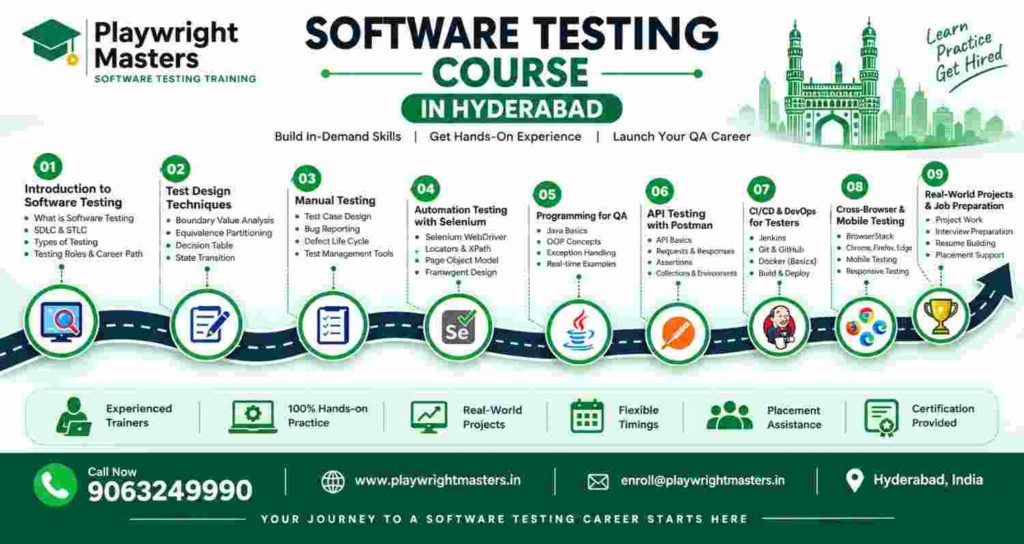
Follow a three-month learning roadmap covering software testing fundamentals, API testing, SQL, automation basics, live projects and career preparation.
Industry | How Software Testing Is Used | Example |
|---|---|---|
Software & Product Engineering | Tests new features, user interfaces, and application functionality to identify bugs before software releases. | Testing teams verify that new updates work correctly without breaking existing features. |
Online Retail & E-commerce | Validates product searches, shopping carts, discount codes, checkout processes, and order management. | Testers ensure customers can apply coupons and complete purchases successfully. |
Banking & Financial Services | Checks secure logins, fund transfers, payment processing, transaction records, and account balances. | Testers verify that money transfers are processed accurately and transaction histories are updated correctly. |
Healthcare & Hospital Platforms | Tests appointment booking, patient registration, prescription management, and medical record systems. | Testing ensures patients can book appointments and access the correct information. |
Insurance & Claims Portals | Validates policy applications, premium calculations, document uploads, and claim processing workflows. | Testers verify that insurance premiums are calculated correctly and claims follow the expected process. |
Travel & Booking Platforms | Checks flight and hotel searches, availability, booking forms, payment processing, and cancellations. | Testers ensure users can book tickets and receive accurate booking confirmations. |
Education & E-learning | Tests student registration, online examinations, course access, fee payments, and learning dashboards. | Testers confirm students can access lessons and submit online exams without errors. |
Telecom & Communication | Validates recharge payments, billing systems, customer accounts, and service activation. | Testing ensures mobile recharges are processed and account balances are updated correctly. |
Healthcare & Retail Mobile Apps | Tests mobile app navigation, notifications, responsiveness, and compatibility across devices. | Testers verify that applications work correctly on different screen sizes and operating systems. |
Enterprise & Business Applications | Checks employee portals, CRM systems, inventory management, reports, and business workflows. | Testers ensure customer records, inventory quantities, and generated reports display accurate data. |

Learn Manual and Automation Testing through practical, industry-focused training.
Understand SDLC, STLC, test cases, test scenarios, defect reporting, and testing techniques.
Apply testing concepts to real-world application workflows and practical QA scenarios.
Practise API validation, SQL queries, data verification, and backend testing concepts.
Strengthen your software testing knowledge and prepare for relevant industry certification exams.
Learn bug reporting, severity vs priority, defect life cycle, and regression testing.
Explore automation fundamentals, programming basics, Selenium, Playwright, and test frameworks.
Understand version control, continuous integration, automated test execution, and test reporting.
Explore ChatGPT and GitHub Copilot for testing tasks, and prepare through resume guidance, mock interviews, and placement assistance.
Traditional TrainingFocus on theory-based software testing concepts.
Playwright Masters TrainingLearn through practical manual and automation testing exercises.
Traditional TrainingLimited hands-on testing assignments.
Playwright Masters TrainingPractise test cases, bug reporting, API testing, and SQL.
Traditional TrainingCovers basic testing concepts only.
Playwright Masters TrainingExplore Selenium, Playwright, and automation fundamentals.
Traditional TrainingGeneric curriculum with limited project exposure.
Playwright Masters TrainingFollow a structured curriculum with real-world testing scenarios.
Traditional TrainingMinimal interview and resume preparation.
Playwright Masters TrainingGet interview practice, resume guidance, and career preparation.
Traditional TrainingLimited practice with real application defects.
Playwright Masters TrainingLearn defect tracking, retesting, and regression testing.
Traditional TrainingLittle exposure to modern testing tools.
Playwright Masters TrainingExplore Git, Jenkins, CI/CD, and AI-assisted testing.
Traditional TrainingLimited flexibility in learning options.
Playwright Masters TrainingChoose available classroom or online instructor-led training.
Traditional TrainingLimited career support after training.
Playwright Masters TrainingReceive placement assistance and job-readiness guidance.
INSTRUCTOR
Mr. Sandeep brings over 10 years of industry experience in software testing, automation, and quality assurance. He has hands-on expertise in manual testing, automation testing, Selenium, Playwright, API testing, and CI/CD practices for real-world applications. His teaching approach focuses on practical learning, helping students understand testing concepts through real-time projects, test case design, bug reporting, framework development, and automation workflows. Having mentored freshers, manual testers, and working professionals, he aims to help every student build job-ready technical skills, gain practical project experience, and develop the confidence needed to pursue Software Tester and Automation Test Engineer roles
Test complete user workflows, including login, form submission, and checkout.
Create test scenarios, test cases, test data, and expected results.
Validate API requests, response data, status codes, and authentication.
Verify database records, data integrity, and query results using SQL.
Verify application features and ensure existing functionality works after changes.
Build automated checks using Selenium or Playwright and understand Git, Jenkins, and CI/CD integration.






At Playwright Masters, our Software Testing Course in Hyderabad includes a 100% placement support program to help students build practical testing skills, prepare for interviews, and pursue job opportunities in top companies.

Resume Building

Placement Training

Interview Questions

Realtime Live Projects

Work together with fellow students on real-world software testing projects, share testing techniques, exchange knowledge, and solve testing challenges as a team.
Access to Resources and Tools
Get access to software testing tools, practice exercises, study materials, interview questions, and learning resources to strengthen your testing skills.
Networking Opportunities
Build your professional network by connecting with software testing trainers, fellow learners, QA professionals, and industry experts in Hyderabad.
Mentorship from Industry Professionals
Learn from experienced testing professionals who provide practical guidance, real-world project insights, and career advice.
Job Support & Career Development
Prepare for software testing job opportunities with resume guidance, mock interviews, interview preparation, and placement assistance.
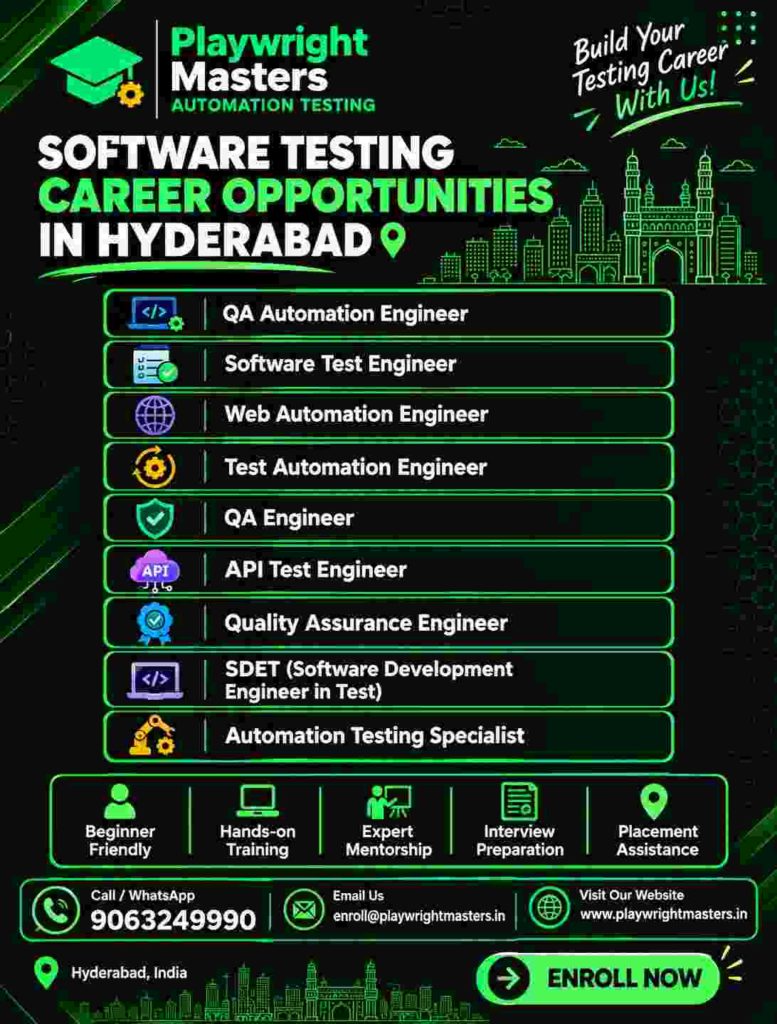
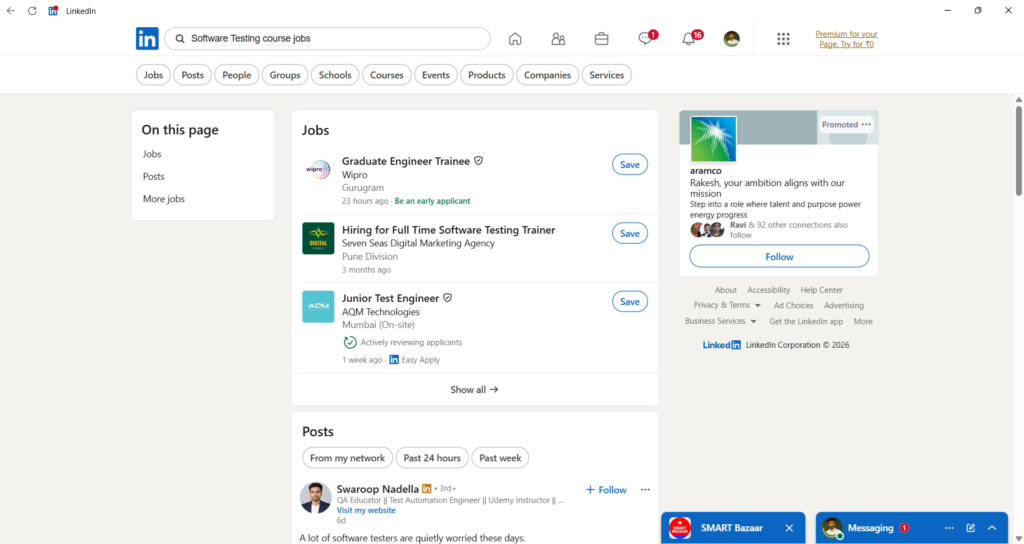
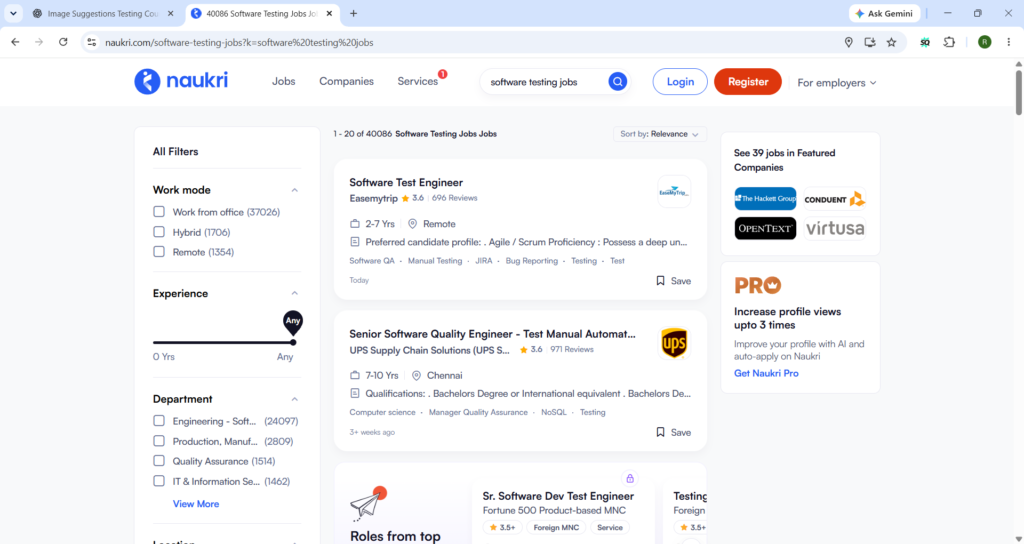
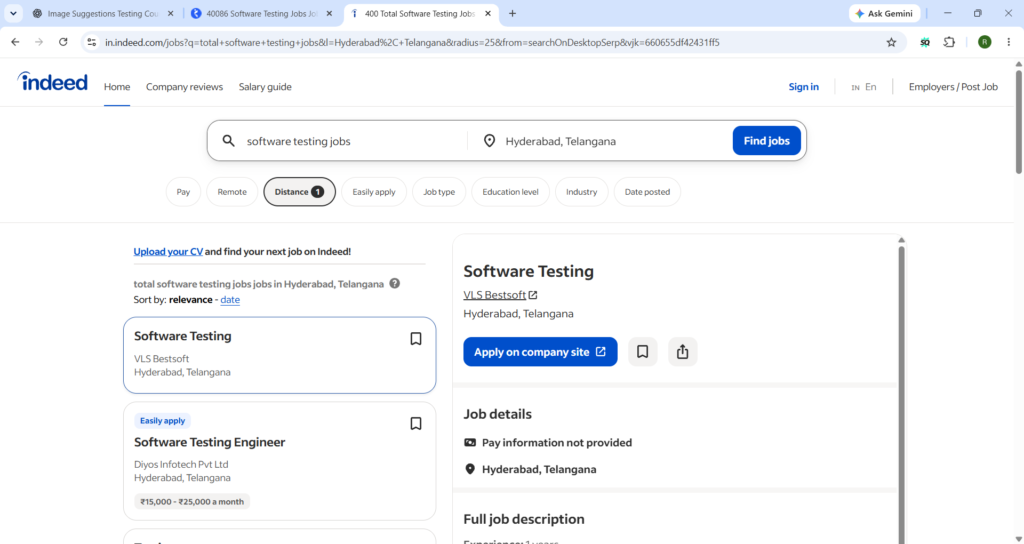
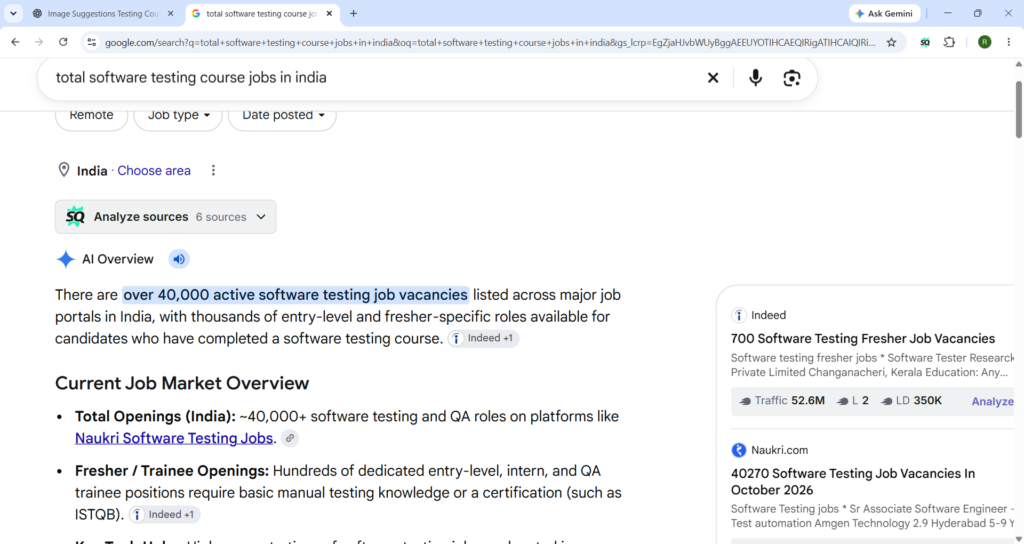
| Experience Level | Salary Range (Approx.) | Key Insights |
|---|---|---|
| Freshers (0–1 Year) | ₹2.5–5 LPA | Entry-level roles include Manual Tester, QA Analyst, and Junior Software Test Engineer. |
| Mid-Level (2–5 Years) | ₹5–10 LPA | Skills in Selenium, Playwright, API Testing, SQL, and Automation Frameworks can support career growth. |
| Senior (5+ Years) | ₹10–20 LPA+ | Experienced professionals can pursue Senior QA Engineer, SDET, Test Lead, and QA Architect roles. |
| Overall Salary | Varies by Experience | Salary depends on skills, experience, company, and job responsibilities. |


50+ batches completed
10+ years in automation testing training
800+ students Trained
Pioneer in the Industry
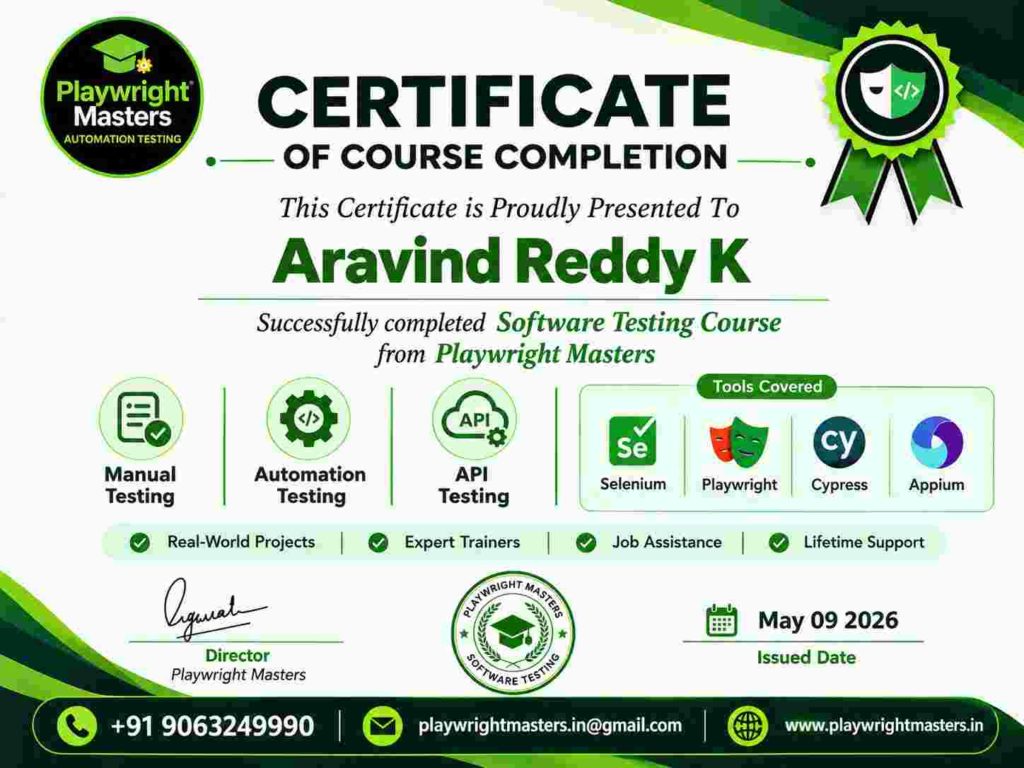
A course completion certificate records completion of the institute’s requirements. It is different from an independent professional qualification. If certification preparation matters to you, review the official ISTQB Foundation Level information and ask whether preparation or an examination voucher is included in your chosen programme.
I had a good learning experience with PlaywrightMasters in Hyderabad. The Software Testing Course covers important testing concepts in a structured way, making it easier to understand the complete testing process. The training focuses on software testing fundamentals, test case design, defect identification, bug reporting, and automation testing concepts. The explanations were clear, and the practical examples helped me understand how testing activities are performed in real-world projects. I would recommend PlaywrightMasters to anyone looking to strengthen their software testing knowledge and develop relevant technical skills.
As an IT professional, I wanted to improve my understanding of software testing methodologies and modern automation practices. I found the training at PlaywrightMasters useful because the course follows a structured learning approach and covers concepts relevant to software quality assurance. The practical examples helped me understand test execution, identifying application defects, and the importance of maintaining reliable test cases. The trainer also provided guidance on important technical concepts and industry practices. Overall, it is a good learning option for working professionals who want to enhance their testing knowledge and explore further opportunities in QA and automation testing.
PlaywrightMasters provides a structured learning experience for people interested in software testing and automation. I particularly appreciate the focus on understanding testing fundamentals before moving into more advanced concepts. Topics such as test case preparation, bug reporting, functional testing, regression testing, and automation workflows are important for building a strong foundation. The practical explanations made the concepts easier to understand and helped me connect theoretical knowledge with real testing scenarios. Anyone planning to develop software testing skills should consider the course based on their learning goals and the technologies included in the syllabus.
My experience with the Software Testing Course at PlaywrightMasters was positive. The training sessions were informative, and the topics were explained in a clear and understandable manner. Software testing involves several important concepts, including understanding requirements, preparing test cases, identifying defects, executing tests, and reporting results. The structured approach helped me understand how these activities fit into the software development life cycle. I also appreciated the opportunity to clarify technical doubts and learn through practical examples. The course can be a useful choice for students, freshers, and professionals who want to improve their understanding of software testing and QA practices.
For anyone planning to build a career in software testing, developing both theoretical knowledge and practical skills is important. PlaywrightMasters offers a learning path that introduces essential software testing concepts and automation testing practices. The course helped me understand the importance of test case design, defect lifecycle management, functional testing, regression testing, and quality assurance. These concepts are relevant when preparing for software testing interviews and understanding workplace responsibilities. I recommend reviewing the course syllabus and practical training coverage to ensure it matches your career goals. Overall, it is a useful training option for learners interested in growing their knowledge of software testing.
I was looking for software testing training in Hyderabad that would help me build a better understanding of QA processes and automation testing. PlaywrightMasters offers a structured approach to learning important testing concepts, from the fundamentals to practical testing scenarios. The course covers areas that help learners understand how applications are tested, how defects are documented, and why test execution and regression testing are important for software quality. The learning approach is helpful for people who want to improve their technical knowledge and understand modern software testing practices. I would suggest this institute to anyone considering software testing training in Hyderabad, provided the syllabus and training format meet their individual requirements.
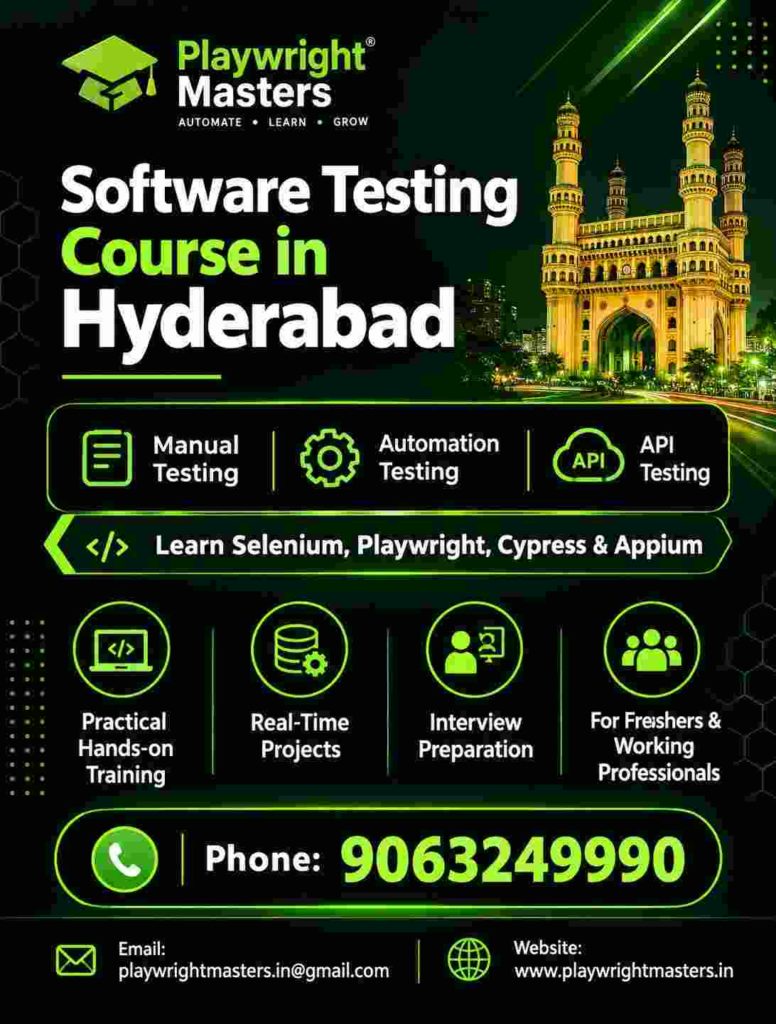
Software testing provides the reasoning; Playwright helps automate selected browser and API checks. You still need to identify the correct business rule, choose test data and interpret a failure. Automation makes a check repeatable, but it does not choose the right checks for you.
The best Software Testing Course in Hyderabad should cover manual testing, automation testing, SQL, API testing, test case design, defect tracking, and real-time projects. Students should compare the syllabus, practical training, trainer experience, course duration, and interview preparation before selecting an institute. PlaywrightMasters provides software testing training information and course guidance to help learners understand testing concepts and automation tools.
A Software Testing Course typically covers software testing fundamentals, SDLC, STLC, manual testing, test case design, bug life cycle, Agile and Scrum, Jira, SQL, database testing, API testing, Postman, automation testing, Selenium, Playwright, Git, and CI/CD fundamentals. The exact syllabus depends on the training institute and selected course.
Manual testing involves executing test cases manually to verify whether an application works as expected. Automation testing uses scripts and tools to execute predefined tests automatically. Manual testing is useful for exploratory testing and usability checks, while automation is valuable for repetitive regression tests, faster feedback, and frequent releases. Both approaches are important in modern software testing.
Yes, beginners can start learning software testing without prior coding knowledge. Manual testing introduces fundamental concepts such as test cases, test scenarios, defect reporting, and the software testing life cycle. Students can gradually learn programming fundamentals when moving into automation testing with tools such as Selenium or Playwright.
Yes, a Software Testing Course can be suitable for freshers who want to understand software quality assurance and testing. Beginners should focus on manual testing, SQL, API testing, test case writing, bug reporting, and automation fundamentals. Building practical projects and preparing for technical interviews can help freshers demonstrate their skills when applying for entry-level QA positions.
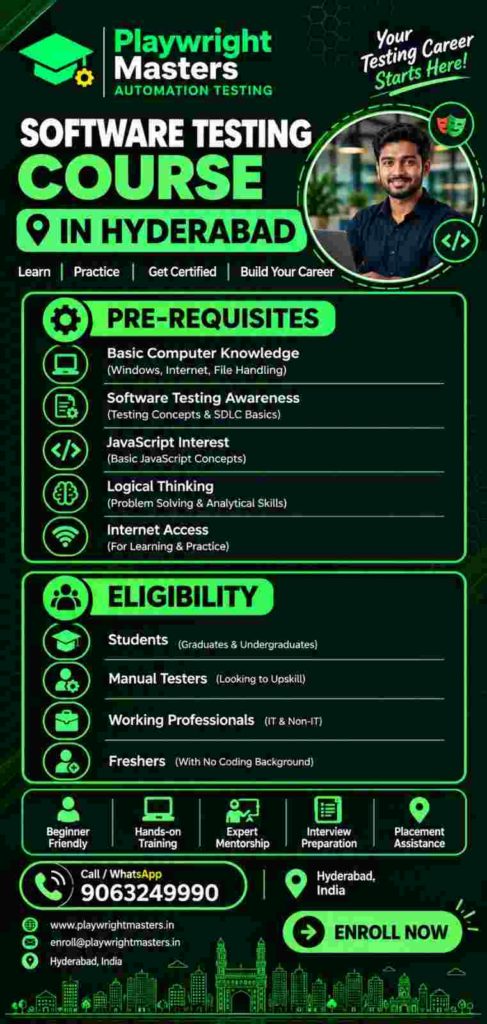
Eligibility requirements vary by training institute and course. Many beginner-level software testing courses accept learners with basic computer knowledge, while some employers prefer candidates with a degree or relevant technical background. Students should check the institute's admission requirements and the qualifications expected for the jobs they want to pursue.
The time required to learn software testing depends on your previous knowledge, study schedule, and course syllabus. Basic manual testing concepts may take several weeks to understand, while learning SQL, API testing, programming, automation frameworks, and real-time project workflows requires additional practice. Consistent hands-on learning is more important than completing lessons quickly.
Software Testing Course fees in Hyderabad vary depending on the syllabus, training format, course duration, practical projects, and tools covered. Before enrolling, compare the complete syllabus, classroom or online options, trainer support, project access, and any additional charges. Contact the training institute directly for the current fee and available batches.
A comprehensive Software Testing Course syllabus should include software testing fundamentals, SDLC, STLC, manual testing, test case design techniques, defect management, Agile and Scrum, Jira, SQL, database testing, API testing, Postman, automation fundamentals, Selenium or Playwright, Git, CI/CD, real-time projects, and interview preparation. Students should verify which technologies are included in the actual course.
Manual testing can be sufficient for some entry-level testing roles, depending on the employer's requirements. However, many QA positions also value SQL, API testing, Agile knowledge, and automation skills. Learning automation tools such as Selenium or Playwright can expand your technical capabilities and help you apply for a wider range of testing opportunities.
The best programming language depends on the automation tools and projects you want to work with. Java is widely used with Selenium, while JavaScript or TypeScript is commonly used with Playwright. Python is another option for automation testing and scripting. Beginners should choose a language that aligns with their course syllabus, target jobs, and preferred automation framework.
Selenium is a browser automation framework that supports multiple programming languages and browsers. Playwright is a modern browser automation framework with built-in auto-waiting, browser context management, and support for Chromium, Firefox, and WebKit. Both tools are used for web application testing. The best choice depends on project requirements, existing frameworks, team skills, and employer expectations.
API testing verifies whether an application's application programming interfaces work correctly. Testers validate request methods, response status codes, response data, authentication, error handling, and performance-related behavior where applicable. API testing helps identify backend issues without relying entirely on the user interface. Common tools include Postman and automation frameworks that support API requests.
SQL helps software testers retrieve, compare, and validate data stored in relational databases. Testers use queries to check whether application transactions, records, updates, and relationships behave as expected. Knowledge of SELECT statements, filtering, joins, aggregate functions, and subqueries is useful for database testing and many QA roles.
Quality Assurance (QA) focuses on improving the processes used to develop and maintain software quality. Software testing focuses on evaluating an application to identify defects and verify expected behavior. Testing is an important part of quality assurance, but QA can also include process improvement, standards, reviews, and defect-prevention activities.
SDLC stands for Software Development Life Cycle and describes the stages involved in developing software, from requirements and design to development, testing, deployment, and maintenance. STLC stands for Software Testing Life Cycle and focuses on testing activities such as requirement analysis, test planning, test design, environment preparation, test execution, defect reporting, and test closure.
The bug life cycle describes how a defect moves from identification to resolution. Common statuses include New, Assigned, Open, Fixed, Retest, Verified, and Closed. Actual workflows may also include Reopened, Rejected, Duplicate, or Deferred. Understanding defect status, severity, priority, reproduction steps, and supporting evidence helps testers communicate issues effectively with development teams.
Smoke testing is a preliminary check used to determine whether the major functions of a new build work well enough for further testing. Sanity testing is a focused check of specific functionality or changes, often after a small fix or update. Both help teams identify obvious problems early, but they differ in scope and purpose.
Regression testing checks whether existing application functionality continues to work after code changes, bug fixes, integrations, or enhancements. It is especially important when changes may affect previously working features. Regression tests can be executed manually or automated to provide repeatable feedback during development and continuous integration.
Jira is commonly used by software teams to manage tasks, user stories, defects, sprints, and project workflows. Testers can use Jira to report bugs, record reproduction steps, attach screenshots, track defect status, and communicate with developers. Its specific testing capabilities depend on the configuration and any additional test management tools used by the team.
Students should practise testing realistic applications such as login pages, e-commerce websites, registration forms, shopping carts, payment workflows in test environments, and REST APIs. Project activities can include writing test cases, validating databases, reporting defects, testing API responses, automating browser workflows, and documenting test results. Practical projects help learners demonstrate how they apply testing concepts.
Yes, non-IT students can learn software testing if they are willing to develop the necessary technical knowledge and practical skills. They can begin with testing fundamentals, test case design, defect reporting, and basic SQL. Automation testing requires additional learning in programming and automation tools. Job eligibility ultimately depends on individual employer requirements.
Software testing can be a career option for freshers who enjoy analysing application behavior, identifying defects, solving problems, and improving software quality. Potential entry-level roles include QA Tester, Manual Tester, Software Test Engineer, and Junior Automation Tester. Career opportunities depend on technical skills, practical experience, interview performance, and current hiring requirements.
Functional testing verifies whether an application performs the required functions correctly, such as login, search, registration, or checkout. Non-functional testing evaluates quality attributes such as performance, security, accessibility, usability, and reliability. Both types of testing help assess whether software meets its functional requirements and broader quality expectations.
Automation testing uses software tools and scripts to execute tests with less manual intervention. Beginners can study Selenium or Playwright for browser automation, Postman for API testing, SQL for database validation, and Git for version control. The best learning sequence depends on the programming language, target role, and tools included in the training syllabus.
Playwright is an open-source automation framework used to test web applications across Chromium, Firefox, and WebKit. It supports browser interactions, assertions, multiple browser contexts, screenshots, network interception, and automated test execution. Teams can use Playwright to build repeatable end-to-end tests and integrate them into continuous integration workflows.
The Page Object Model (POM) is a design pattern that organizes automation code by representing application pages or components as separate objects. These objects contain locators and methods for interacting with the user interface. POM can improve code reuse, readability, and maintainability when application interfaces or automation tests change.
Software testing can be learned through classroom training, live online classes, self-paced courses, or a combination of these approaches. Classroom learning offers direct interaction, while live online training can provide flexibility for working professionals and students. Compare practical exercises, trainer access, doubt-clearing support, project work, and batch timings before choosing a format.
Prepare by revising manual testing fundamentals, SDLC, STLC, test case design, defect life cycle, SQL, API testing, and Agile concepts. Practise explaining your projects, writing test cases for real-world scenarios, identifying defects, and answering tool-specific questions. If you have learned automation, practise writing scripts, using assertions, debugging failures, and explaining your framework design.
Choose a Software Testing Training Institute in Hyderabad by comparing its syllabus, trainer experience, hands-on exercises, real-time project coverage, batch timings, learning support, and course fees. Ask for a detailed module list and clarify which tools are taught. Check genuine student reviews and request a demo class before making your decision. Select a course that matches your current skill level and career goals.
Explore Playwright web automation, API testing and practical testing frameworks.
Explore browser automation, Selenium WebDriver and practical testing frameworks.

Explore mobile application testing for Android and iOS using Appium.
Contact us and our academic councellor will get in touch with you shortly.