
What Is Playwright? A Complete Guide to Playwright Automation Testing in 2026
If you are learning software testing, you have probably heard the word Playwright many times.
But what exactly is Playwright?
Is it a programming language?
Is it a browser?
Is it the same as Selenium?
Is it only used for testing?
And why are so many developers and QA engineers learning it?
Let’s answer these questions in very simple language.
Table of Contents
ToggleWhat Is Playwright?
Playwright is an open-source web automation framework that allows you to control browsers with code and test modern web applications automatically.
Instead of a person manually opening a website, clicking buttons, entering information and checking the result, Playwright can perform those actions through an automated program.
For example, imagine an online shopping website.
A real customer might:
- Open the website.
- Search for a laptop.
- Select a product.
- Add it to the cart.
- Enter an address.
- Choose a payment option.
- Place the order.
- Check the confirmation message.
A Playwright test can reproduce this journey automatically and verify whether the application behaves as expected.
That is the easiest way to understand Playwright:
Playwright lets your code behave like a user inside a web browser.
Playwright is maintained as an open-source project and currently provides browser automation across Chromium, Firefox and WebKit. It can be used for testing, scripting and browser-based automation.
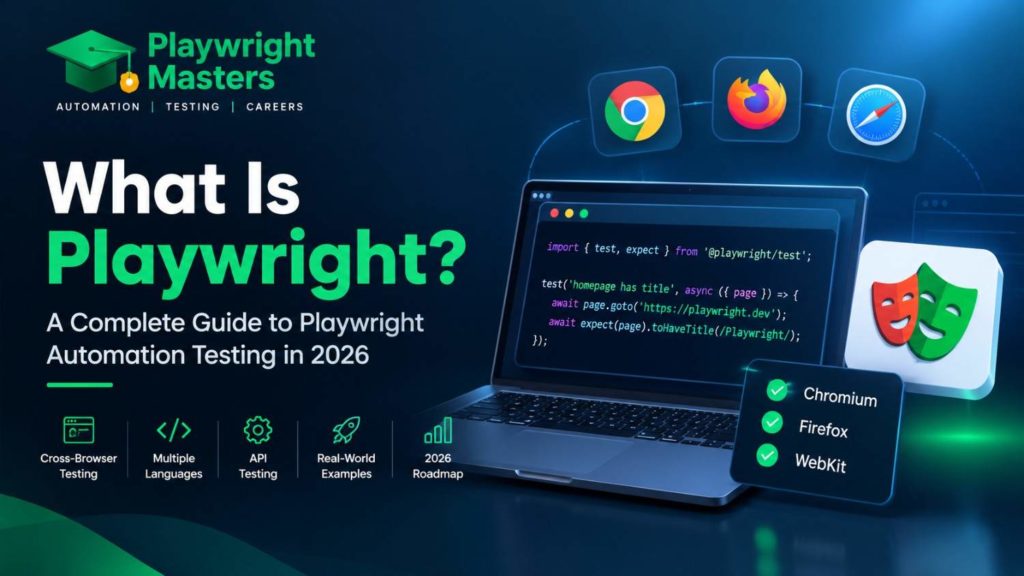
Playwright Explained With a Simple Example
Imagine that you have a website with a Login button.
Normally, a tester might do this:
Open website → enter username → enter password → click Login → check dashboard
If the tester has to repeat this 100 times, it becomes boring and wastes time.
With Playwright, you can write instructions that tell the browser what to do.
For example:
await page.goto(‘https://example.com’);
await page.getByLabel(‘Username’).fill(‘testuser’);
await page.getByLabel(‘Password’).fill(‘password’);
await page.getByRole(‘button’, { name: ‘Login’ }).click();
The computer can perform the same process automatically.
You can then tell Playwright what result you expect.
For example:
await expect(page.getByText(‘Dashboard’)).toBeVisible();
So the basic idea is:
Action + Expected Result = Automated Test
This is one of the most important ideas to understand when starting Playwright.
Is Playwright a Testing Tool or an Automation Tool?
The answer is both, depending on how you use it.
Playwright provides browser automation capabilities.
You can use those capabilities to:
- Test websites
- Automate repetitive browser tasks
- Check user journeys
- Validate web application behavior
- Capture screenshots
- Record test execution
- Interact with multiple pages
- Work with browser sessions
- Monitor network activity
- Test APIs
- Build automated workflows
- Support browser-based AI-agent workflows
For professional software testing, Playwright Test adds a complete testing environment around Playwright.
The official Playwright site describes Playwright Test as a full-featured test runner with capabilities such as auto-waiting, assertions, tracing and parallel execution.
Why Do We Need Playwright?
Let’s understand the problem Playwright solves.
Modern websites are not simple pages anymore.
A modern web application may contain:
- Login systems
- JavaScript
- APIs
- Dynamic content
- Popups
- Multiple browser tabs
- File uploads
- File downloads
- Payment flows
- User dashboards
- Different user roles
- Real-time information
- Responsive layouts
- Third-party services
Testing every possible user journey manually can take a huge amount of time.
Suppose an application has 300 important test cases.
A tester may need to repeat those tests after every major software release.
Instead of manually repeating everything, automation can perform predictable tests again and again.
This is where Playwright becomes useful.
How Does Playwright Work?
Think of Playwright as a translator between your test code and the browser.
You write an instruction.
Playwright communicates with the browser.
The browser performs the action.
Playwright observes the result.
Then your test decides whether the result is correct.
The process looks like this:
Your Test Code
↓
Playwright
↓
Browser
↓
Web Application
↓
Result
↓
PASS or FAIL
For example:
Open Login Page
↓
Enter Username
↓
Enter Password
↓
Click Login
↓
Wait for Dashboard
↓
Check Dashboard
↓
PASS
If the expected dashboard does not appear, the test can fail.
This gives the development and QA team fast feedback.
Which Browsers Does Playwright Support?
Playwright is designed around three major browser engines:
Chromium
Chromium is the browser engine used by browsers such as Google Chrome and Microsoft Edge.
Firefox
Playwright provides automation support for Firefox.
WebKit
WebKit is the browser engine associated with Safari.
This is important because websites can behave differently across browsers.
A page that works perfectly in one browser may have a problem in another browser.
Playwright allows teams to configure projects for Chromium, Firefox and WebKit. It can also work with branded Chrome and Edge installations and emulate selected mobile and tablet devices.
Important 2026 clarification
Do not simply write:
“Playwright runs Safari.”
A more accurate explanation is:
Playwright can automate WebKit, the browser engine associated with Safari, but Playwright’s WebKit build is not the same thing as installing and controlling the branded Safari browser.
This distinction matters when you are explaining Playwright professionally.
Which Programming Languages Does Playwright Support?
Playwright supports multiple programming languages.
The current official documentation lists:
- JavaScript
- TypeScript
- Python
- Java
- .NET
This means you are not forced to learn one particular language just to use Playwright.
However, your choice should depend on your team and project.
For example:
JavaScript / TypeScript
Useful for teams working heavily with the modern web ecosystem.
Python
A popular option for testers and developers who already work with Python.
Java
Useful for teams whose existing automation ecosystem is Java-based.
.NET
Useful for organizations working with Microsoft’s .NET ecosystem.
For beginners, the most important thing is not to learn five languages.
Choose one language and become comfortable with it.
What Is Playwright Test?
This is a question beginners often miss.
There is a difference between Playwright and Playwright Test.
Playwright provides the browser automation capabilities.
Playwright Test provides a testing framework around those capabilities.
It gives you tools for things such as:
- Writing tests
- Running tests
- Assertions
- Fixtures
- Test isolation
- Parallel execution
- Retries
- Projects
- Configuration
- Reports
- Traces
- Debugging
This distinction becomes important when you start building a professional automation framework.
What Can You Test With Playwright?
Playwright can be used for many types of web testing.
1. End-to-End Testing
End-to-end testing checks a complete user journey.
For example:
Login
↓
Search
↓
Open Product
↓
Add to Cart
↓
Checkout
↓
Order Confirmation
Instead of checking each button separately, you can test whether the entire journey works.
2. UI Testing
UI testing checks how the user interface behaves.
You can automate:
- Buttons
- Forms
- Menus
- Links
- Search boxes
- Checkboxes
- Radio buttons
- Dropdowns
- Tables
- Dialogs
For example, you might check whether clicking Submit displays the correct success message.
3. API Testing
Playwright is not limited to browser clicks.
It also provides APIs for making HTTP requests and checking responses.
That means you can test application APIs without necessarily driving the user interface for every test.
For example:
Send Request
↓
Receive Response
↓
Check Status
↓
Check Response Data
↓
PASS / FAIL
The official documentation provides APIRequestContext for API testing and for preparing application state.
4. Cross-Browser Testing
You can use the same automation approach to test different browser engines.
For example:
Test
├── Chromium
├── Firefox
└── WebKit
This can help identify browser-specific problems.
5. Responsive Web Testing
A website should work on different screen sizes.
Playwright can emulate selected mobile and tablet device configurations.
For example:
Desktop
Tablet
Mobile
This is useful when checking responsive web applications.
6. Authentication Testing
Most real applications have login systems.
Playwright provides browser-context isolation and mechanisms for reusing authenticated browser state.
For example:
Admin
Customer
Manager
Guest
Each user can have a different session.
The official documentation recommends storing authentication state carefully and keeping authentication-state files out of source repositories because they can contain sensitive cookies and headers.
7. Network Testing and Mocking
Modern web applications communicate with servers through network requests.
Playwright can monitor and modify HTTP and HTTPS traffic.
You can also mock API responses.
For example, suppose your application depends on a payment API.
Instead of calling the real payment service during every test, you can simulate a response.
Application
↓
Mock API
↓
Fake Response
↓
Application Behavior
This can make certain tests safer, faster and easier to reproduce.
The official documentation provides network interception and API mocking capabilities through browser-context routing.
10 Important Playwright Features
Now let’s look at the features that make Playwright useful.
1. Auto-Waiting
Timing problems are common in browser automation.
Imagine a button appears after a few seconds.
A weak automation script might immediately try to click it.
Playwright can wait for an element to become actionable before performing many actions.
This reduces the need for unnecessary fixed delays.
2. Web-First Assertions
An assertion asks:
“Did the application produce the result I expected?”
For example:
await expect(page).toHaveTitle(/Playwright/);
Assertions are a critical part of automation because clicking something is not enough.
You need to verify the result.
3. Powerful Locators
A locator tells Playwright which element you want.
For example:
page.getByRole(‘button’, { name: ‘Login’ })
Other locator approaches include:
- Role
- Text
- Label
- Placeholder
- Test ID
- CSS
- XPath
Playwright Codegen can recommend locators while recording interactions and prioritizes approaches such as role, text and test IDs.
4. Browser Contexts
This is one of Playwright’s most useful concepts.
A BrowserContext gives you an independent browser session.
Imagine three customers:
Customer A → Session A
Customer B → Session B
Customer C → Session C
Their cookies and storage can remain separate.
The official documentation describes browser contexts as independent browser sessions and explains that they do not share cookies or cache with other contexts.
5. Test Isolation
Imagine Test A logs in as an administrator.
Then Test B unexpectedly starts with the administrator’s session.
That can create confusing failures.
Playwright’s isolation model helps each test start from a clean environment.
The official documentation explains that browser contexts provide isolated environments and help prevent failures from one test affecting another.
6. Parallel Testing
Suppose you have 100 tests.
Running every test one after another can take considerable time.
Parallel execution allows suitable tests to run simultaneously.
This can reduce total execution time when your environment and test design support parallel execution.
7. Codegen
If you are a beginner, Codegen is useful for understanding how browser actions translate into Playwright code.
Run:
npx playwright codegen https://example.com
Then interact with the website.
Playwright can generate code based on those interactions and suggest locators.
But remember:
Codegen is a starting tool, not a replacement for learning automation.
Generated code still needs to be reviewed and maintained.
8. Trace Viewer
When a test fails, reading a simple error message may not always be enough.
Trace information can help you understand what happened during the test.
The current Playwright tooling includes traces with information such as actions, DOM snapshots, network requests, console information and screenshots.
This makes debugging much easier.
9. Screenshots and Videos
You can configure Playwright to capture screenshots and videos during test execution.
These artifacts can help answer questions such as:
What did the browser look like when the test failed?
That is especially useful in CI environments where you cannot watch the test running on your own computer.
10. AI and Browser Automation
Playwright’s role is also expanding beyond traditional testing.
The current official Playwright project includes tooling aimed at browser automation for coding agents and AI-agent workflows, including Playwright CLI and Playwright MCP.
This does not mean Playwright has stopped being a testing framework.
Instead, it means browser automation is becoming useful for a wider range of software workflows.
For a 2026 Playwright learner, understanding this broader ecosystem is valuable.
What Is a Playwright Locator?
A locator answers a simple question:
Which element do I want to use?
Imagine a webpage contains five buttons.
Your test needs to click Login.
Playwright needs a reliable way to identify that button.
For example:
page.getByRole(‘button’, { name: ‘Login’ })
Good locator design is extremely important.
If your locator depends on something that changes frequently, your test may break unnecessarily.
This is why professional Playwright testers learn locator strategies instead of simply copying whatever selector appears first.
What Is Auto-Waiting in Playwright?
Suppose a page takes two seconds to display a button.
If your script tries to click immediately, the test might fail.
One beginner solution is:
await page.waitForTimeout(2000);
But fixed delays are usually a poor long-term strategy.
The better approach is to let Playwright wait for the required condition where its built-in waiting behavior applies.
This is one reason Playwright can make modern dynamic applications easier to automate.
What Is Playwright Codegen?
Codegen means code generation.
Playwright opens a browser and records your interactions.
For example:
Open website
↓
Click Login
↓
Enter username
↓
Enter password
↓
Click Submit
It can produce corresponding Playwright code.
This is useful when:
- You are learning
- You want to discover locators
- You want a quick starting point
- You want to explore an unfamiliar page
But a professional tester should still understand the generated code.
What Is Playwright Trace Viewer?
Trace Viewer is a debugging tool.
Imagine your test fails at step 27.
You want to know:
- What page was open?
- What action happened before the failure?
- What did the DOM look like?
- What network activity occurred?
- What did the screenshot show?
Tracing helps you investigate the execution rather than simply guessing.
Playwright vs Selenium
One of the biggest questions beginners ask is:
Playwright vs Selenium — which is better?
The honest answer is:
Neither tool is automatically the best choice for every project.
Selenium is a mature automation ecosystem with a long history.
Playwright is a newer automation ecosystem designed around modern browser automation.
A simplified comparison:
Area | Playwright | Selenium |
Browser automation | Yes | Yes |
Chromium | Yes | Yes |
Firefox | Yes | Yes |
WebKit | Yes | Not the same Playwright WebKit approach |
Auto-waiting | Strong built-in model | Different approach |
Browser contexts | Native Playwright concept | Different session model |
API testing | Available | Usually combined with other tools |
Parallel testing | Playwright Test supports it | Common through Selenium Grid/ecosystem |
Test tracing | Strong built-in tooling | Uses different tooling |
Languages | JS/TS, Python, Java, .NET | Broad language ecosystem |
Ecosystem maturity | Newer | Very mature |
The important question is not:
“Which tool is famous?”
Ask:
“Which tool best suits your application, team expertise, and overall testing strategy?”
Playwright vs Cypress
Playwright and Cypress are both popular choices for web testing.
They have different architectures and workflows.
Playwright is particularly useful when your project requires capabilities such as:
- Multiple browser engines
- Multiple pages
- Browser-context isolation
- Network control
- API interaction
- Cross-browser projects
- Parallel test execution
- Complex end-to-end workflows
Cypress can also be an excellent choice for appropriate projects.
A good engineer understands the strengths and limitations of both rather than choosing a tool only because it is trending.
Advantages of Playwright
Here are some practical reasons teams choose Playwright.
Cross-browser automation
You can work with Chromium, Firefox and WebKit.
Automatic waiting
Playwright’s actionability model can reduce timing-related problems.
Test isolation
Browser contexts provide separate environments.
Parallel execution
Suitable tests can execute simultaneously.
Strong debugging
Trace Viewer, screenshots, videos and reports help investigate failures.
API support
You can combine browser-based and API-level testing.
Network control
You can monitor and mock network requests.
Multiple languages
“Playwright supports JavaScript, TypeScript, Python, Java, and .NET.”
Modern browser tooling
Codegen, UI Mode, VS Code tooling and newer agent-oriented tools extend the development workflow.
These capabilities are documented in the current Playwright ecosystem.
Limitations of Playwright
Being honest about limitations makes a technical article more useful.
Playwright does not replace programming
If you want to become a professional automation tester, you need programming fundamentals.
Playwright does not magically create perfect tests
A poor locator can still create a poor test.
Bad test data can still cause failures.
Poor application design can still create difficult automation.
It is mainly for web applications
Playwright is designed around browser and web automation.
It should not be described as a universal tool for native Android and iOS application testing.
Framework design still matters
A large test suite needs organization.
You may need:
- Reusable utilities
- Fixtures
- Page objects
- Test data management
- Environment configuration
- Reporting
- CI/CD
- Version control
The tool helps you build automation.
It does not design your automation strategy for you.
Who Should Learn Playwright?
Playwright can be useful for:
Manual Testers
If you want to move from manual testing into automation, Playwright can be a useful skill.
Automation Testers
Existing automation engineers can use Playwright to build modern browser test suites.
Selenium Testers
Selenium experience gives you useful testing concepts that can help when learning Playwright.
Developers
Developers can automate important user journeys and regression tests.
QA Engineers
QA engineers can use Playwright for UI, API and end-to-end testing.
SDETs
SDETs can use Playwright as part of larger automation frameworks and CI/CD pipelines.
What Should You Learn Before Playwright?
You do not need to know everything about software development.
But you should understand some basics.
First: Software Testing
Learn:
- What is a test case?
- What is a defect?
- What is regression testing?
- What is smoke testing?
- What is functional testing?
- What is automation testing?
Second: Programming
Choose one language.
For example:
- JavaScript
- TypeScript
- Python
- Java
- C#
Learn basic:
- Variables
- Functions
- Conditions
- Loops
- Arrays
- Objects
- Classes
- Modules
- Async programming
Third: Playwright
Then learn:
Installation
↓
First Test
↓
Locators
↓
Actions
↓
Assertions
↓
Auto-Waiting
↓
Fixtures
↓
Browser Contexts
↓
Authentication
↓
API Testing
↓
POM
↓
Parallel Testing
↓
Reporting
↓
CI/CD
This approach is much better than trying to memorize hundreds of Playwright commands.
How to Install Playwright
If you are using the JavaScript/TypeScript Playwright Test setup, the official project initializer can be started with:
npm init playwright@latest
Playwright then guides you through project setup.
After installation, Playwright also manages its supported browser binaries through its CLI. The official documentation recommends keeping Playwright updated and reinstalling the browser binaries when required by an update.
How to Install Playwright , Complete Guide
A Simple Playwright Learning Roadmap
“If you’re starting from scratch, follow this step-by-step order.” : Playwright Roadmap
Level 1 — Foundations
Learn:
- Software testing
- JavaScript/TypeScript or another supported language
- HTML
- CSS basics
- Browser basics
Level 2 — Playwright Basics
Learn:
- Installation
- Test structure
- Locators
- Actions
- Assertions
- Navigation
- Auto-waiting
Level 3 — Real Automation
Learn:
- Forms
- Dropdowns
- Checkboxes
- File upload
- File download
- Multiple tabs
- Popups
- Frames
- Dialogs
Level 4 — Framework Skills
Learn:
- Fixtures
- Page Object Model
- Test data
- Configuration
- Authentication
- Browser contexts
- Reusable utilities
Level 5 — Advanced Testing
Learn:
- API testing
- Network interception
- Mocking
- Parallel execution
- Projects
- Reporting
- Trace Viewer
Level 6 — Professional Skills
Learn:
- Git
- GitHub
- CI/CD
- Jenkins or GitHub Actions
- Docker basics
- Framework architecture
- Real-world projects
What Projects Can You Create With Playwright?
Reading tutorials is not enough.
You become better by building projects.
Try projects such as:
Project 1: Login System
Automate:
Valid Login
Invalid Login
Logout
Forgot Password
Session Validation
Project 2: E-Commerce Website
Test:
Search
Product Details
Cart
Checkout
Order
Project 3: Employee Management System
Test different roles:
Admin
Manager
Employee
Project 4: API + UI Framework
Combine:
API Setup
↓
UI Test
↓
API Validation
↓
Database/Application State
Project 5: CI/CD Automation
Push your code to GitHub.
Then configure a CI pipeline to run Playwright automatically.
That is much closer to real-world automation engineering than simply completing tutorial examples.
Is Playwright Good for Beginners?
Yes, but there is an important condition.
Do not start by memorizing advanced Playwright commands.
Start with the basics.
Imagine learning to drive a car.
You first learn:
- Steering
- Braking
- Accelerating
- Traffic rules
You don’t begin by learning how to repair the engine.
Playwright is similar.
Start with:
Testing + Programming + Basic Playwright
Then gradually move to:
Framework + API + Authentication + CI/CD
This makes learning much easier.
Is Playwright Worth Learning in 2026?
Playwright is an important modern browser automation technology and its official ecosystem continues to expand.
The current project covers traditional end-to-end testing while also providing tooling around browser automation, AI-agent workflows, test generation, tracing and developer tooling.
But don’t learn Playwright only because someone says:
“Playwright has jobs.”
Learn it because you want to understand how modern web applications can be tested and automated reliably.
That skill is more valuable than memorizing a particular tool’s commands.
Final Takeaway
If you remember only one definition from this entire article, remember this:
Playwright is an open-source browser automation framework that lets developers and testers control modern web browsers with code and build reliable automated tests and browser workflows.
It can work with Chromium, Firefox and WebKit.
It supports JavaScript, TypeScript, Python, Java and .NET.
It can automate user actions, verify application behavior, test APIs, isolate browser sessions, run tests in parallel, generate test code, inspect failures and integrate with modern development workflows.
But becoming a good Playwright tester is not about memorizing commands.
It is about learning how to answer one important question:
“How can I verify that this web application works correctly for real-world users?”
Playwright gives you the automation tools.
Your testing knowledge gives those tools a purpose.
Start with one test.
Understand it.
Change it.
Break it.
Debug it.
Improve it.
Then build a bigger project.
That is how you move from knowing what Playwright is to actually using Playwright like a professional automation tester.
Frequently Asked Questions About Playwright
What is Playwright in simple words?
Playwright is a tool that allows your computer program to control a web browser and automatically test or automate websites.
Is Playwright free?
The Playwright project is open source. Commercial cloud platforms that provide additional browser infrastructure or testing services can have separate pricing.
Who created Playwright?
Playwright was introduced by Microsoft and is maintained as an open-source project.
Is Playwright a programming language?
No.
Playwright is an automation framework and toolset. You use a supported programming language such as JavaScript, TypeScript, Python, Java or .NET to work with it.
Is Playwright a browser?
No.
Playwright controls browsers. It can install and automate supported browser builds such as Chromium, Firefox and WebKit.
Is Playwright only for testing?
No.
Testing is a major use case, but Playwright can also be used for browser automation, scripting and newer agent-oriented browser workflows.
Can Playwright test APIs?
Yes.
Playwright provides API request functionality that can be used to send HTTP requests and validate responses.
Can Playwright test mobile websites?
Yes.
Playwright can emulate selected mobile and tablet device configurations for web testing.
Can Playwright test native mobile apps?
Playwright is primarily a web browser automation and web application testing tool. It should not be confused with native mobile application testing frameworks.
Is Playwright better than Selenium?
Not universally.
Playwright has modern browser automation capabilities that make it an excellent choice for many projects, while Selenium remains a mature and widely used automation ecosystem.
Choose based on project requirements rather than popularity alone.
Is Playwright difficult to learn?
The first concepts are relatively simple.
Professional Playwright automation becomes more advanced when you learn programming, framework architecture, API testing, authentication, debugging and CI/CD.
Which language is best for Playwright?
There is no universal best language.
Choose the language that matches your team’s ecosystem and your career goals.
What is Playwright Test?
Playwright Test is the testing framework built around Playwright that provides features such as test execution, assertions, fixtures, isolation, parallelism, configuration and reporting.
What is Playwright Codegen?
Codegen is Playwright’s test-generation tool. It records browser interactions and can generate Playwright code and recommend locators.
What is a BrowserContext?
A BrowserContext is an isolated browser session. Different contexts can have separate cookies, storage and sessions.
What is Playwright auto-waiting?
Playwright automatically waits for elements to become actionable for supported actions instead of requiring you to add fixed delays everywhere.
What is Playwright Trace Viewer?
Trace Viewer helps you investigate what happened during a test execution, making it easier to debug failures.
Does Playwright support Chrome?
Yes. Playwright can run against Chromium and can also use installed branded Chrome through supported browser channels.
Does Playwright support Edge?
Yes. Playwright can work with Microsoft Edge through its supported browser channel configuration.
Does Playwright support Safari?
Playwright automates WebKit rather than directly controlling the branded Safari browser. For Safari-like engine coverage, WebKit testing is the relevant Playwright capability.
Can I learn Playwright without Selenium?
Yes.
You do not need to learn Selenium first.
However, understanding general automation concepts will make learning Playwright easier.
Can a manual tester learn Playwright?
Yes.
A manual tester can move into Playwright automation by learning programming fundamentals and automation concepts step by step.
Is Playwright useful for QA jobs?
Yes, Playwright is a valuable automation skill. But job readiness requires more than Playwright syntax. Learn testing fundamentals, programming, API testing, Git, CI/CD and real project development as well.
Playwright Masters Team
Playwright Automation Testing Experts | Industry-Focused Training & Practical Learning
Playwright Masters is a dedicated automation testing training platform focused on helping learners build practical skills in Playwright automation testing. Our training covers real-world automation concepts, framework practices, coding, debugging, API testing, cross-browser testing, CI/CD, and interview preparation to help learners develop job-ready testing skills.